
Glock has introduced the sixth generation of its popular striker-fired pistol platform, bringing some of the most noticeable ergonomic and feature changes the company has made in years.
Officially announced in December 2025 and launched at SHOT Show 2026, the initial Glock Gen 6 pistol lineup includes the Glock 17 Gen 6, Glock 19 Gen 6, and Glock 45 Gen 6, with all three models chambered in 9mm Luger.
Rather than completely redesigning the platform, Glock used Gen 6 to refine several areas that directly affect how the pistol feels and interfaces with the shooter.
A redesigned frame, RTF6 grip texture, flat-faced trigger, deeper slide serrations, enlarged beavertail, extended thumb rest, and updated optic-ready mounting system distinguish the new generation from earlier Glock pistols.
For shooters already familiar with Glock handguns, Gen 6 represents an evolution of the company’s established design.
For shooters considering their first Glock, the new generation provides three different pistol configurations built around many of the same core Gen 6 features.
When Did Glock Gen 6 Come Out?
Glock officially announced its sixth generation of pistols on December 6, 2025. The company initially revealed three models: the Glock 17 Gen 6, Glock 19 Gen 6, and Glock 45 Gen 6.
The pistols began arriving at authorized U.S. Glock dealers on January 20, 2026, coinciding with the official Gen 6 launch at SHOT Show 2026.
The timing also marked an important milestone for the company. The year 2026 represents the 40th anniversary of Glock pistol sales in the United States.
Glock established its U.S. subsidiary in Smyrna, Georgia, in 1985, before its polymer-framed pistols entered the American market the following year.
Glock’s introduction of Gen 6 continues the gradual evolution of a pistol platform that has been used by civilian shooters, competitors, military personnel, and law enforcement agencies around the world.
What Glock Gen 6 Models Are Available?
Glock 17 Gen 6
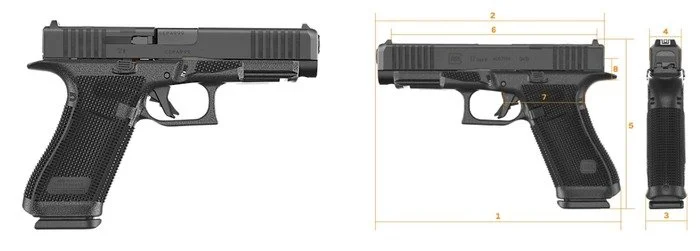
The Glock 17 Gen 6 carries forward Glock’s full-size 9mm configuration. The original Glock 17 established the basic design that would eventually become the foundation for much of the company’s pistol lineup.
The larger frame provides a full grip and makes the G17 suitable for applications such as recreational shooting, training, competition, and duty use where the dimensions of a full-size handgun are appropriate.
With Gen 6, the G17 receives the redesigned frame geometry, expanded grip texture, flat-faced trigger, deeper slide serrations, and factory optic-ready system shared across the new generation.
Glock 19 Gen 6
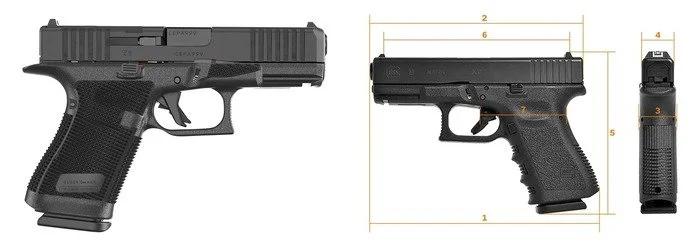
The Glock 19 Gen 6 offers a more compact version of the standard Glock platform.
Historically, the G19’s combination of reduced dimensions and double-stack 9mm configuration has allowed it to fill several roles. Its smaller overall size compared with the G17 can make the pistol easier to carry while retaining enough grip and slide length for regular range use.
The Gen 6 version combines this established compact format with Glock’s latest ergonomic and optic-mounting updates.
Glock 45 Gen 6
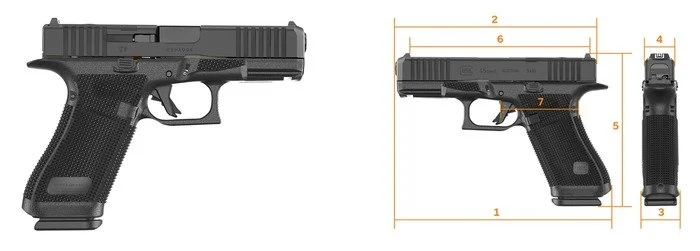
The Glock 45 Gen 6 uses Glock’s crossover-style configuration, pairing a compact-length slide with a full-size frame.
This arrangement gives shooters the shorter slide profile associated with the compact platform while retaining the larger grip dimensions of a full-size pistol.
Like the G17 and G19, the G45 Gen 6 incorporates the updated Gen 6 frame, grip texture, trigger, slide serrations, and optic-ready configuration.
What’s New With Glock Gen 6?
The most significant Glock Gen 6 changes center on ergonomics, shooter interface, and optic compatibility rather than a complete departure from Glock’s established operating system.
Redesigned Grip Geometry
One of the most visible Gen 6 changes is the redesigned grip.
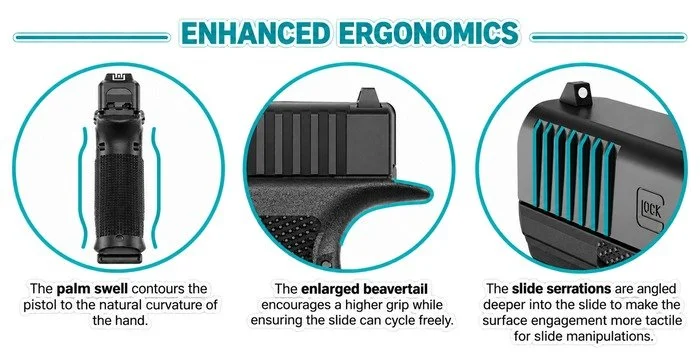
Glock incorporated a palm swell, extended thumb rest, and enlarged beavertail into the new frame geometry. Together, these changes alter the interface between the shooter’s hand and the pistol.
The enlarged beavertail provides additional surface area toward the rear of the frame, while the revised grip profile is intended to create a more natural hand position.
This is particularly significant because Glock has historically taken a relatively conservative approach to changing the basic shape of its frames.
New RTF6 Grip Texture
Gen 6 introduces Glock’s RTF6 grip texture, which combines two textures and extends the textured surface into additional areas of the frame.
Earlier Glock generations also used textured polymer frames, but Gen 6 increases the amount of textured surface available to the shooter’s hands.
The texture now extends into areas such as the thumb rest, creating more contact between the hand and textured portions of the frame.
Flat-Faced Trigger
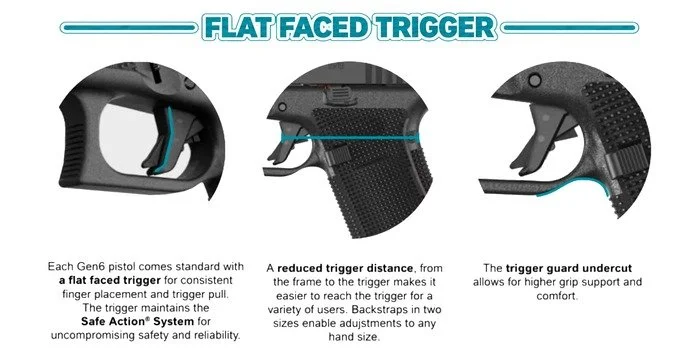
Another immediately recognizable Gen 6 feature is the new flat-faced trigger.
Glock also reduced the distance between the frame and trigger while adding an undercut trigger guard. These changes are intended to improve trigger reach and allow the shooter to establish a higher grip on the pistol.
Despite the redesigned trigger shoe, Gen 6 pistols continue to use Glock’s Safe Action System. The Glock Safe Action System incorporates three internal mechanical safeties that operate sequentially as part of the pistol’s firing system.
Undercut Trigger Guard
The trigger guard has also been reshaped. An undercut trigger guard creates additional room for the shooter’s hand to sit higher on the frame. Combined with the revised grip geometry and reduced trigger distance, this represents one of several Gen 6 changes focused specifically on the shooter’s interaction with the pistol.
Deeper Angled Slide Serrations
Glock redesigned the slide serrations for Gen 6. The new serrations are deeper and angled into the slide, increasing the available surface engagement when manipulating it.
Slide serrations are a relatively small component of a handgun, but they play a practical role whenever the slide must be manually operated during loading, unloading, inspection, or routine handling.
Enlarged Beavertail and Thumb Rest
The Gen 6 frame includes both an enlarged beavertail and extended thumb rest. These features work alongside the new grip geometry rather than functioning as isolated additions.
Collectively, the palm swell, beavertail, thumb rest, undercut trigger guard, and expanded grip texture represent one of the largest ergonomic revisions in the Gen 6 platform.
Glock Gen 6 vs Gen 5: What’s Different?
The transition from Glock Gen 5 to Gen 6 is primarily defined by changes to ergonomics, controls, grip texture, and optic mounting.
Gen 5 already introduced substantial changes compared with earlier Glock generations, including the removal of finger grooves, an ambidextrous slide stop lever, a flared magazine well on many models, and other internal and external revisions.
Gen 6 builds on that foundation with a more extensively reshaped frame. Among the most noticeable Gen 6 updates are:
Redesigned grip geometry with a palm swell
RTF6 grip texture with greater surface coverage
Extended thumb rest
Enlarged beavertail
Undercut trigger guard
Reduced trigger reach
Flat-faced trigger
Deeper angled slide serrations
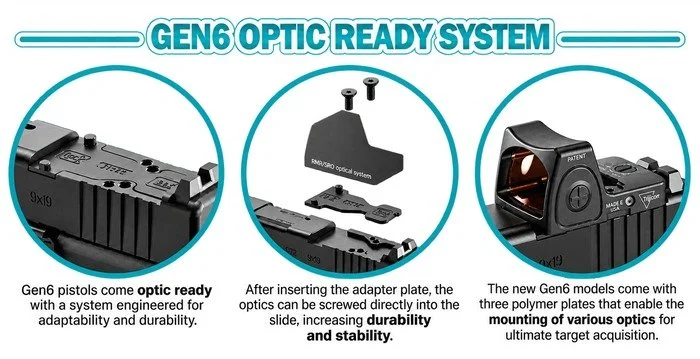
New factory optic-ready mounting system
The result is not an entirely different pistol operating concept. Gen 6 retains recognizable elements of the Glock platform, including the polymer frame, striker-fired action, and Safe Action System.
Instead, the sixth generation places greater emphasis on how the shooter physically interfaces with the pistol.
Is Glock Gen 6 Compatible With Older Glock Accessories?
Accessory compatibility deserves additional attention when moving between Glock generations.
Although the G17, G19, and G45 model names remain familiar, changes to the Gen 6 frame and internal geometry mean shooters should not automatically assume that every Gen 5 or earlier component is compatible with Gen 6.
Holsters are one example. Some manufacturers have confirmed that particular existing holsters fit Gen 6 pistols, while others offer products specifically identified for Gen 6.
Compatibility can depend on the holster design, pistol model, mounted optic, weapon light, or other accessories.
Aftermarket internal components require even greater caution. Parts that physically fit are not necessarily appropriate or safe for a different generation.
Owners should use components specifically approved for the applicable pistol and generation and follow the firearm and component manufacturers’ instructions.
The same principle applies to optic mounting. Gen 6 uses its own optic-ready system, so shooters should consult Glock’s current compatibility chart to determine the correct plate and mounting hardware for a particular optic.
Final Thoughts on the Glock Gen 6 Pistol Lineup
The Glock Gen 6 pistol lineup represents a substantial ergonomic update to one of the shooting industry’s most established striker-fired handgun platforms.
Instead of replacing the basic Glock formula, the sixth generation concentrates on areas where shooters interact directly with the firearm.
The redesigned grip geometry, RTF6 texture, enlarged beavertail, extended thumb rest, undercut trigger guard, flat-faced trigger, deeper slide serrations, and updated optic-ready system collectively distinguish Gen 6 from the generation that came before it.
The initial Glock 17 Gen 6, Glock 19 Gen 6, and Glock 45 Gen 6 also give shooters three familiar configurations to consider: full-size, compact, and crossover.
As the Gen 6 family develops, additional models or configurations may eventually broaden the lineup.
For now, these three 9mm pistols establish the foundation for Glock’s sixth generation and provide the clearest indication of how the company intends to evolve its pistol platform for today’s shooting market.
